
By Abdullahi Jamaa
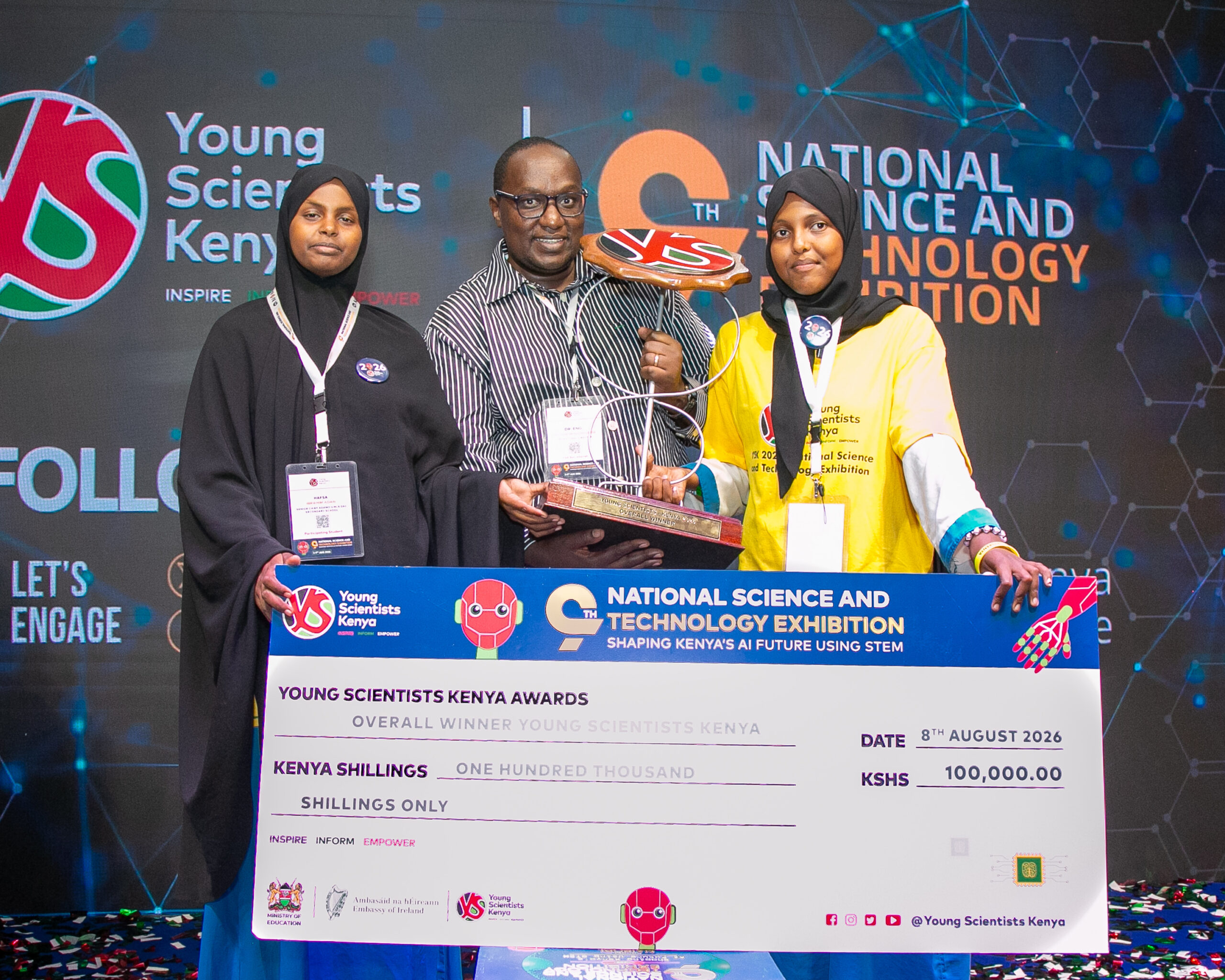
NAIROBI, Kenya — Two students from Senior Chief Adano Girls Day Secondary School in Wajir County have won the top prize at the ninth Young Scientists Kenya National Science and Technology Exhibition with an artificial intelligence system designed to predict drought risks in climate-vulnerable communities.
Hafsa Ibrahim Adan and Asha Harun Yarow were named overall winners for developing an AI-Based Environmental Monitoring and Drought Risk Prediction System for Climate-Vulnerable Communities in Northeastern Kenya.
The system uses sensors to collect data on soil moisture, temperature, humidity and rainfall. An artificial intelligence model then analyses the information to generate a drought-risk score, including the likelihood of drought and the confidence level of the prediction.
It also estimates the number of days remaining before drought conditions are likely to develop.
The technology is intended to provide an early warning that could help farmers and communities prepare for worsening conditions by managing water resources, adjusting irrigation and protecting crops and livestock.
As overall winners, the two students each received KSh 50,000, a fully funded STEM course scholarship at Strathmore University and a smartphone sponsored by Safaricom.
They will also travel to Dublin, Ireland, to represent Kenya at the BT Young Scientist and Technology Exhibition.
The achievement places Wajir students at the centre of a national competition focused on using science and technology to address challenges affecting Kenyan communities, particularly in areas vulnerable to climate shocks.
The exhibition was held at Moi Girls High School in Nairobi under the theme, “Shaping Kenya’s AI Future Using STEM.” It brought together 308 finalists from 125 schools after more than 1,500 project submissions were received from across the country.
Second place went to three students from Zad Muslim School in Marsabit County for Eco-Guard, an automated smart garden designed to conserve water, protect crops and improve environmental management.
The system combines a greenhouse structure with automated irrigation and temperature controls. A soil-moisture sensor activates a water pump when the soil becomes dry, while a temperature sensor opens the roof when temperatures inside the garden rise above a set level.
The projects from Wajir and Marsabit reflect the practical challenges facing communities in Kenya’s arid and semi-arid regions, where drought, water scarcity and food insecurity continue to affect livelihoods.
Evelyn Maris, deputy head of mission at the Embassy of Ireland in Kenya, said Ireland’s partnership with Young Scientists Kenya was aimed at supporting innovation, science and education.
“The programme aligns with our ambitions around innovation, science and education,” Maris said, according to the post.
Ireland was among the initiative’s founding partners in 2017. Maris said the Kenyan programme draws from Ireland’s Young Scientist and Technology Exhibition, which has operated since the 1960s.
Chief Guest Mahboob Bajwa, deputy representative for programmes at UNICEF Kenya, said the exhibition demonstrated the role young people can play in the country’s technological development.
“Kenya’s AI future will not be built by algorithms alone. It will be built by young people,” Bajwa said.
The 2026 exhibition also recorded increased participation by girls, who formed the majority of participants and featured prominently among the winners. More than 20 students from refugee camps participated with UNICEF support, with several receiving awards.
Dr. Victor Mwongera, national director of Young Scientists Kenya, said expanding opportunities for students was essential to encouraging innovation.
“It is not a lack of resources that hampers innovation, but rather a lack of opportunity,” Mwongera said.
All category winners will take part in a STEM Boot Camp where industry partners will help them refine their prototypes, learn about intellectual property protection and develop their ideas beyond the exhibition.
Young Scientists Kenya says it has reached more than 280,000 students since its establishment nine years ago. The organisation plans to increase the number of finalists to more than 500 as it prepares for its 10th year, while also creating opportunities for former participants to return as mentors.


