

By Hassan Abdi Omar
Sometimes, the most powerful ideas begin with a simple question: What can we do about the problem we see around us?
For Hafsa Ibrahim Adan and Asha Harun Yarow, two Form 3 students from Senior Chief Adano in Wajir County, that question led somewhere remarkable. Living in a region scarred by repeated droughts and climate change, they developed an AI-based environmental monitoring and drought risk prediction system designed to help vulnerable communities anticipate crises before they become catastrophic.
What makes their achievement truly impressive is not that they employed artificial intelligence. Rather, it is that they examined a problem destroying their own community and resolved to solve it. Against the odds, they succeeded.
For families in Wajir, drought is not merely a classroom topic or policy discussion. It is lived reality: disrupted livelihoods, children withdrawn from school, household resources depleted, and communities fragmented.
This context makes Hafsa and Asha’s innovation extraordinary. They did not develop their system in a Nairobi technology hub or university laboratory. They developed it in a community where drought shapes daily existence.
Their innovation transforms lived experience into knowledge, and knowledge into actionable solutions, creating an opportunity for communities and decision-makers to prepare before crisis strikes.
Real world
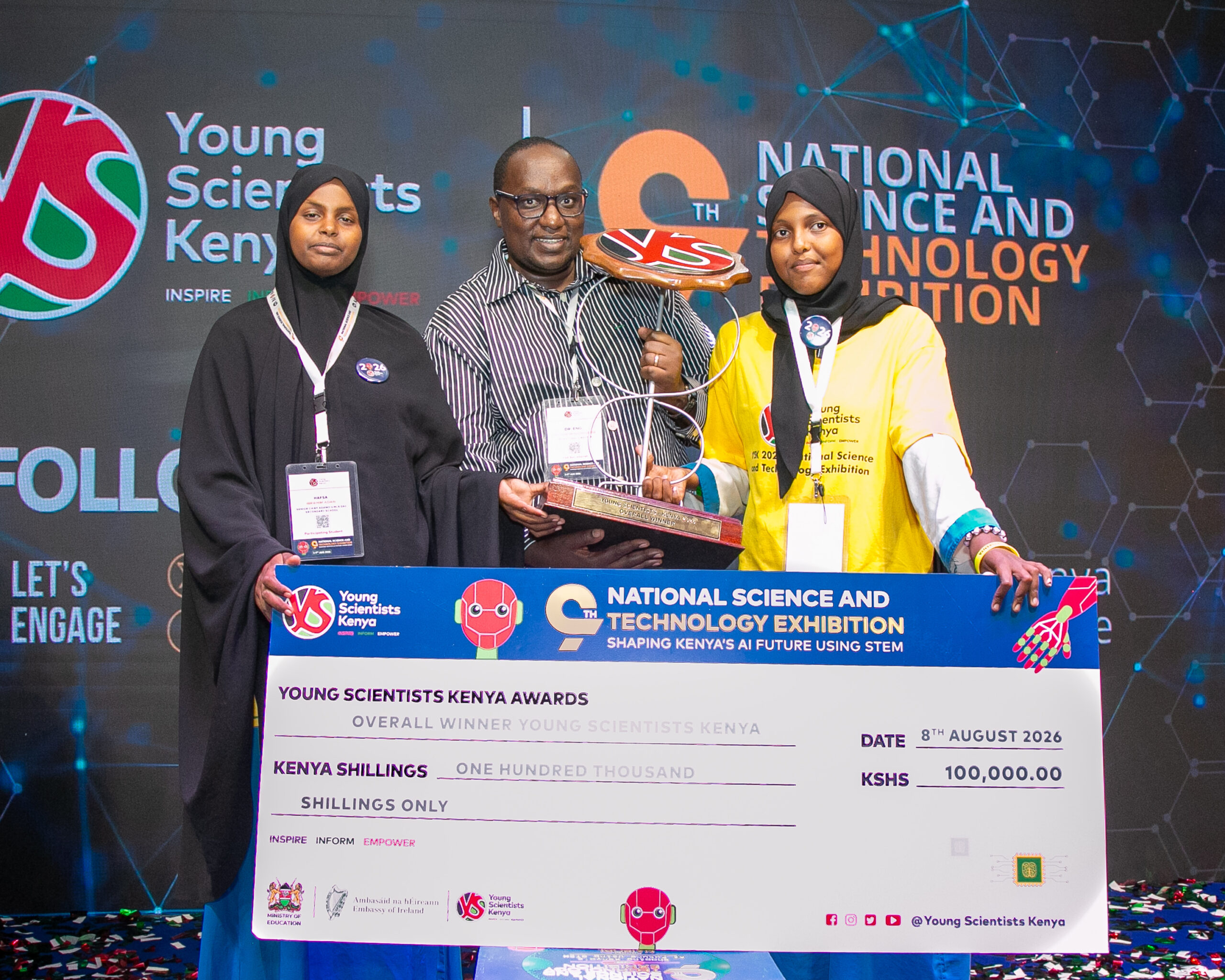
Hafsa and Asha’s achievement raises a crucial question about education: Are we providing young people with sufficient opportunities to apply what they learn in school to solve the problems they observe in their communities?
Students in pastoral communities study mathematics, physics, biology, and geography much like their peers elsewhere. However, often a significant gap emerges between classroom learning and lived reality.
Hafsa and Asha bridged that gap. They examined their environment, explored artificial intelligence and data analysis, and treated their idea not as a school project destined for obscurity, but as something with genuine potential to benefit their community.
This is the calibre of learning that education should cultivate.
Education must transcend mere examination preparation. It should foster the confidence to ask critical questions, experiment boldly, learn from failure, discover solutions, and believe that individual ideas hold value.
Young innovators
The most significant lesson from Hafsa and Asha’s story may not concern them directly. Rather, it pertains to the countless others sitting in classrooms across Wajir, Garissa, Mandera, Marsabit, and Isiolo who harbour equally powerful ideas.
How many students have identified community problems but lack knowledge of where to present their ideas? How many possess curiosity yet lack a mentor? How many conceive brilliant ideas but lack access to computers, laboratories, internet connectivity, innovation spaces, or financial resources?
How many promising ideas remain confined to classrooms because the young innovators behind them lack access to the opportunities they deserve?
These questions demand substantive answers from educators, parents, policymakers, and development partners.
Kenya has earned a distinguished reputation as Africa’s innovation and technology centre. The country’s expanding technology ecosystem has generated numerous impressive solutions and entrepreneurs.
However, access to innovation opportunities remains unevenly distributed. Young innovators in Wajir, Garissa, Mandera, and other pastoral regions encounter significant barriers: locating mentors, connecting with technology experts, accessing innovation facilities, and identifying organisations capable of helping develop their ideas.
Hafsa and Asha’s success merits celebration yet it should inspire deeper reflection. Their recognition, scholarships, and international exposure are undoubtedly valuable. Nevertheless, we cannot permit such opportunities to depend on chance, exceptional circumstances, or fortuitous connections.
A talented student in Wajir should have a realistic opportunity to find a mentor. A student in Mandera should be able to access innovation resources. A young person in Garissa should be able to develop promising ideas without requiring relocation to Nairobi to obtain support.
This is the pathway through which we cultivate an innovation culture that genuinely belongs to all of Kenya.
Climate leadership
Climate change discourse frequently portrays arid and semi-arid communities solely through the lens of vulnerability. While accurate, this description is incomplete.
Young people residing in these communities possess climate knowledge that textbooks cannot impart. They comprehend what drought means for their families. They witness the consequences of water scarcity. They understand how environmental change fundamentally reshapes livestock systems, livelihoods, and educational opportunities.
This knowledge is invaluable. Hafsa and Asha remind us that young people in climate-vulnerable communities should not be regarded merely as beneficiaries of climate programmes. They are innovators, problem-solvers, and potential leaders in climate adaptation and resilience.
Their achievement provides schools with a practical roadmap for fostering innovation:
First, connect learning to local context. A lesson on climate change becomes profoundly meaningful when students examine drought patterns in their own communities. Mathematics becomes relevant through analysing rainfall data. Geography gains significance through studying local land and water resource changes. Computer studies evolves into a pathway for developing digital solutions to authentic community problems.
Second, create space for experimentation. Not every school requires expensive laboratories or sophisticated technology hubs. Often, what proves most transformative is a teacher who believes in a student’s idea and says: Let us explore where this can lead.
Third, invest in mentorship. Young innovators require guidance from someone who can help transform exciting ideas into viable projects, someone who can challenge, encourage, and connect students to emerging opportunities.
Finally, establish pathways beyond school competitions. An innovation should not conclude when certificates are distributed or exhibitions close. When ideas demonstrate genuine potential, universities, technical institutions, private companies, county governments, and development partners should facilitate young innovators in taking the subsequent step.
There is compelling reason to celebrate Hafsa and Asha’s accomplishments. Their creativity is inspiring. Their determination is commendable. Their achievement exemplifies what young people can accomplish when they assume ownership of challenges affecting their communities.
However, their story must not conclude here. It should catalyse a broader conversation regarding the education system Kenya endeavours to construct.
A system wherein students think beyond examinations. Wherein teachers receive support to nurture creativity. Wherein innovation opportunities reach students beyond major urban centres. Wherein a young person from Wajir can pursue ambitions, experiment, and create without geography limiting possibility.
Most critically, we require an education system that teaches young people that the problems they identify in their surroundings are not inherently someone else’s responsibility to address. Occasionally, they possess the capacity to become the solution-makers themselves.
Hafsa and Asha’s AI-based drought prediction system represents far more than a technical accomplishment. It serves as a powerful reminder of what transpires when education, curiosity, and lived experience converge.
Their story demonstrates that some of Kenya’s most valuable innovations may originate from the communities facing the greatest challenges.
However, we must not restrict ourselves to celebrating them through words alone. We must actively establish conditions enabling thousands of additional young innovators to follow their exemplary path.
Because the next transformative innovation need not emerge from a Nairobi technology hub. It could be developing right now in a Form 3 classroom in Wajir. It could be forming within the mind of a young student examining a community challenge and quietly pondering:
What if we tried something different?


2 Comments. Leave new
Mashaa Allah and congratulations to our girls who have displayed- in an extra ordinary way- possibilities of Northern Kenya. With necessary support and mentorship, our daughters and sons will certainly excel in their various fields.
Thank you Mr. Hassan for your thoughtful recommendations to policy makers and educators.
Wajir learners have equal potentials as those in other parts of the world. Many of their ideas are shuttered by lack of opportunities. Given the opportunities and the relevant infrastructure the learners from Northern part will make a change.