

By Abdullahi Jamaa
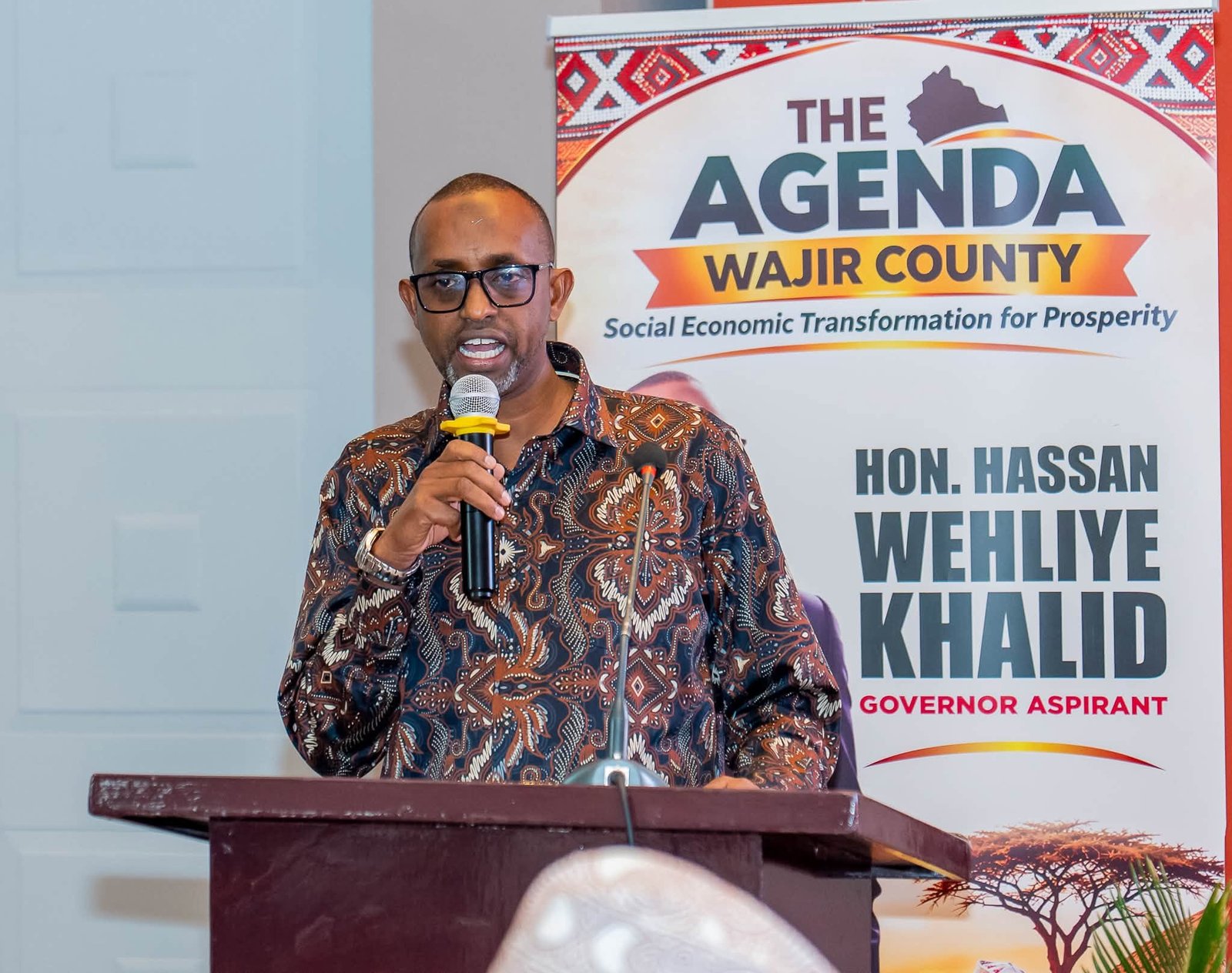
Wajir gubernatorial aspirant Hassan Wehliye Khalid has unveiled an ambitious five-year development agenda promising sweeping reforms in healthcare, livestock production, water security, education and public financial management if elected governor in the 2027 General Election.
The manifesto, titled The Agenda: Wajir Transformation for Socioeconomic Prosperity, 2027–2032, was launched at Pullman Hotel in Upper Hill, Nairobi, on Saturday, bringing together political leaders, professionals and other prominent personalities from across Northern Kenya.
At the centre of the proposed programme is an overhaul of Wajir’s healthcare system, including upgrading Wajir County Referral Hospital into a fully equipped Level 5 facility, establishing functional Level 3 health centres in every ward and strengthening specialised medical services across the county.
Wehliye also proposes transforming the county’s livestock economy through improved animal breeds, commercial livestock fattening, dairy development and the operationalisation of the Wajir International Abattoir.
The proposals seek to address longstanding development challenges in a county where pastoralism remains the backbone of livelihoods, while limited infrastructure, water scarcity and inadequate access to specialised services continue to constrain economic opportunities.
In healthcare, the aspirant promises to establish a rapid results initiative to address medicine shortages and malfunctioning equipment, alongside a digitally connected health system linking facilities, medical personnel, ambulance services and referral networks.
The plan further proposes mobile maternal and child health outreach services to improve access to vaccinations, antenatal care, nutrition interventions and specialised clinics, particularly in remote settlements.
Under the livestock sector, Wehliye proposes establishing a County Animal Diagnostic Centre supported by satellite cold-chain facilities in all sub-counties to strengthen disease surveillance, vaccination and veterinary services.
He also wants to establish a County Livestock Investment Company to oversee the commercialisation and management of the Wajir International Abattoir and public slaughterhouses.
The manifesto identifies livestock fattening, breed improvement, fodder production, dairy processing and poultry enterprises as priority areas for investment, with cooperatives and private-sector partnerships expected to play a central role.
According to the manifesto, Wajir has approximately 0.8 million cattle, 2.3 million sheep, 3.2 million goats and 1.2 million camels. The sector contributes an estimated 70 per cent of household income and food security in normal seasons.
Beyond pastoralism, the proposed agenda seeks to expand commercial agriculture, citing the county’s estimated 5,134.45 square kilometres of potentially cultivable land, of which only 3,120 hectares are currently under food crop cultivation.
The candidate proposes irrigation schemes, commercial fruit farming, drought-resilient cereals, modern storage facilities and agricultural cooperatives. He also identifies beekeeping and gum and resin production as alternative sources of income, particularly for women and young people.
Water security is another major priority, with proposals to modernise the Wajir Water and Sewerage Company, rehabilitate existing infrastructure, map water sources digitally and introduce reverse osmosis technology to make saline groundwater usable.
The manifesto also proposes public-private partnerships to finance large-scale dams and water pans, alongside digital water kiosks to improve access and management.
On education and youth empowerment, Wehliye pledges to establish digital innovation hubs across all 15 sub-counties and a Wajir Talent and Excellence Academy headquartered at Wajir Stadium, with satellite centres across the county.
Other proposals include expanding vocational training, introducing a Women in Technical Skills Scholarship Programme and supporting school feeding, bursaries and girls’ sanitary programmes.
The manifesto also proposes a Wajir Gender Empowerment Fund targeting women, youth and persons with disabilities, as well as a county gender-based violence referral centre supported by sub-county facilities.
On infrastructure and trade, the aspirant wants Wajir positioned as a commercial gateway to Northern Kenya and the Horn of Africa. His proposals include improving the Wajir–Isiolo and Wajir–Mandera roads, expanding Wajir International Airport’s cargo-handling capacity and establishing a County Industrial Development Agency to attract investors.
The document estimates Wajir’s pending bills at KSh5.5 billion and unremitted statutory deductions at KSh1.5 billion. It also places the county’s wage bill at between 40.5 and 42.6 per cent of total revenue, above the 35 per cent ceiling under the Public Finance Management Act.
Wehliye proposes payroll audits, a phased settlement of verified pending bills, digital revenue collection and electronic government procurement to address financial pressures and strengthen transparency.
He further proposes establishing a County Budget and Economic Council to involve citizens in financial decision-making and a Governor’s Delivery Unit to monitor flagship projects and departmental performance.
The manifesto outlines an implementation framework spanning quick wins within six months, short-term interventions over 6–18 months, medium-term programmes over 18–36 months and longer-term investments extending beyond three years.
It also acknowledges that major projects will depend on feasibility assessments, available financing, statutory approvals and partnerships with the national government and development agencies.
The launch marks Wehliye’s formal entry into the contest for the Wajir governorship ahead of the 2027 elections, with his manifesto presenting a broad development agenda centred on economic diversification, improved public services and financial accountability.
The proposals now place implementation capacity, financing and the ability to translate the commitments into measurable improvements in residents’ lives at the centre of the political debate.


