

By Abdullahi Jamaa | Wajir Today | Monday, June 1, 2026
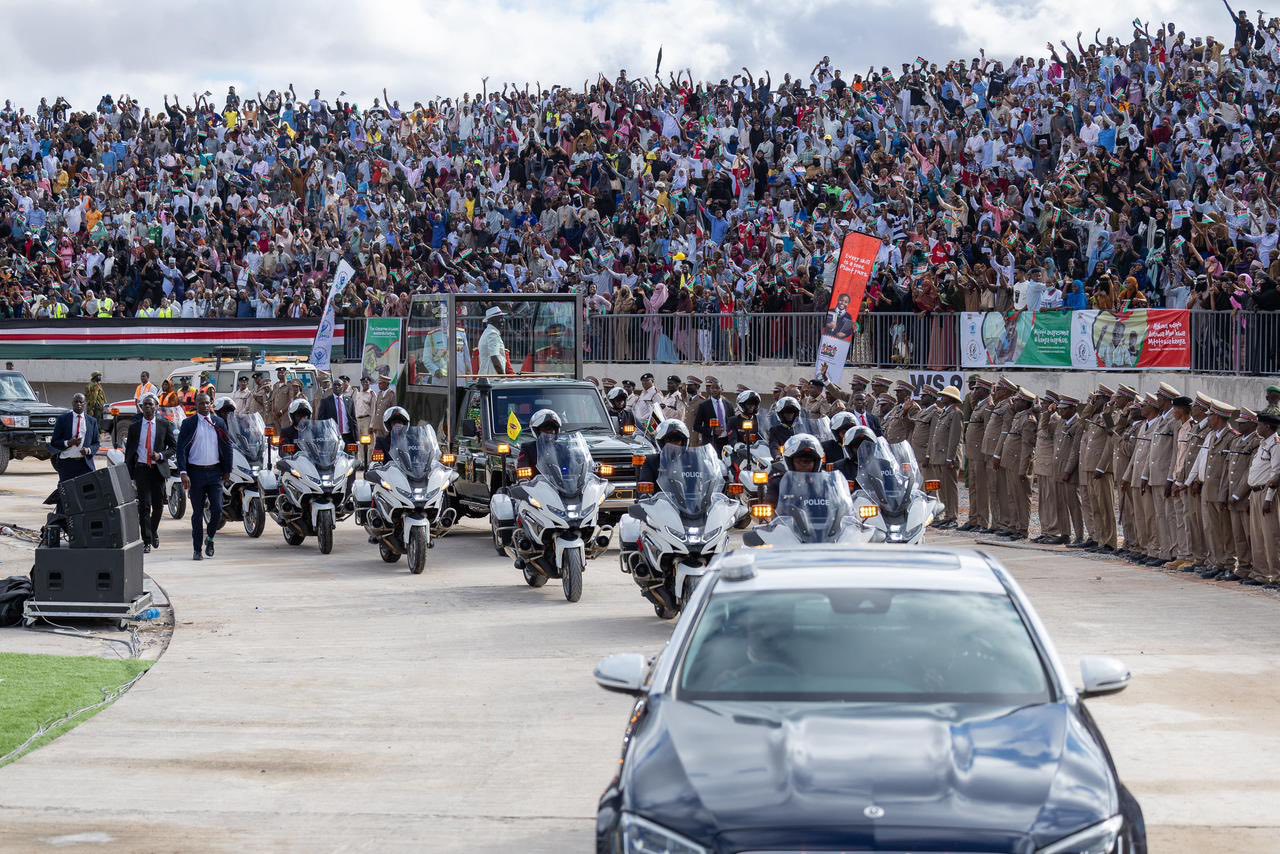
Thousands of Kenyans gathered in Wajir on Monday as the country marked its 63rd Madaraka Day celebrations, the first time the national event has been held in Kenya’s North Eastern region.
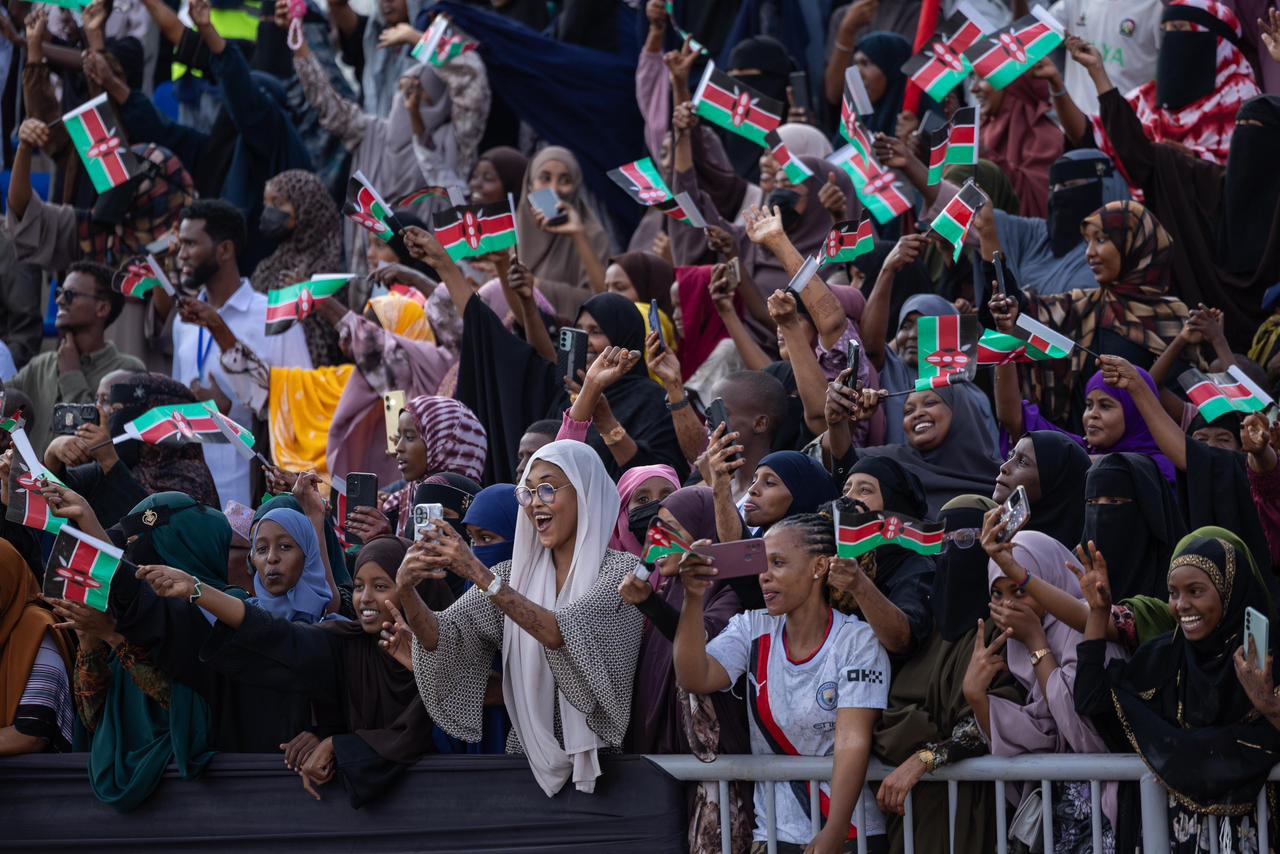
A sea of black, red, green and white filled the newly built 10,000-seater Wajir Stadium as residents, visitors, government officials and invited guests assembled for the annual commemoration of Kenya’s attainment of internal self-rule from British colonial administration in 1963.
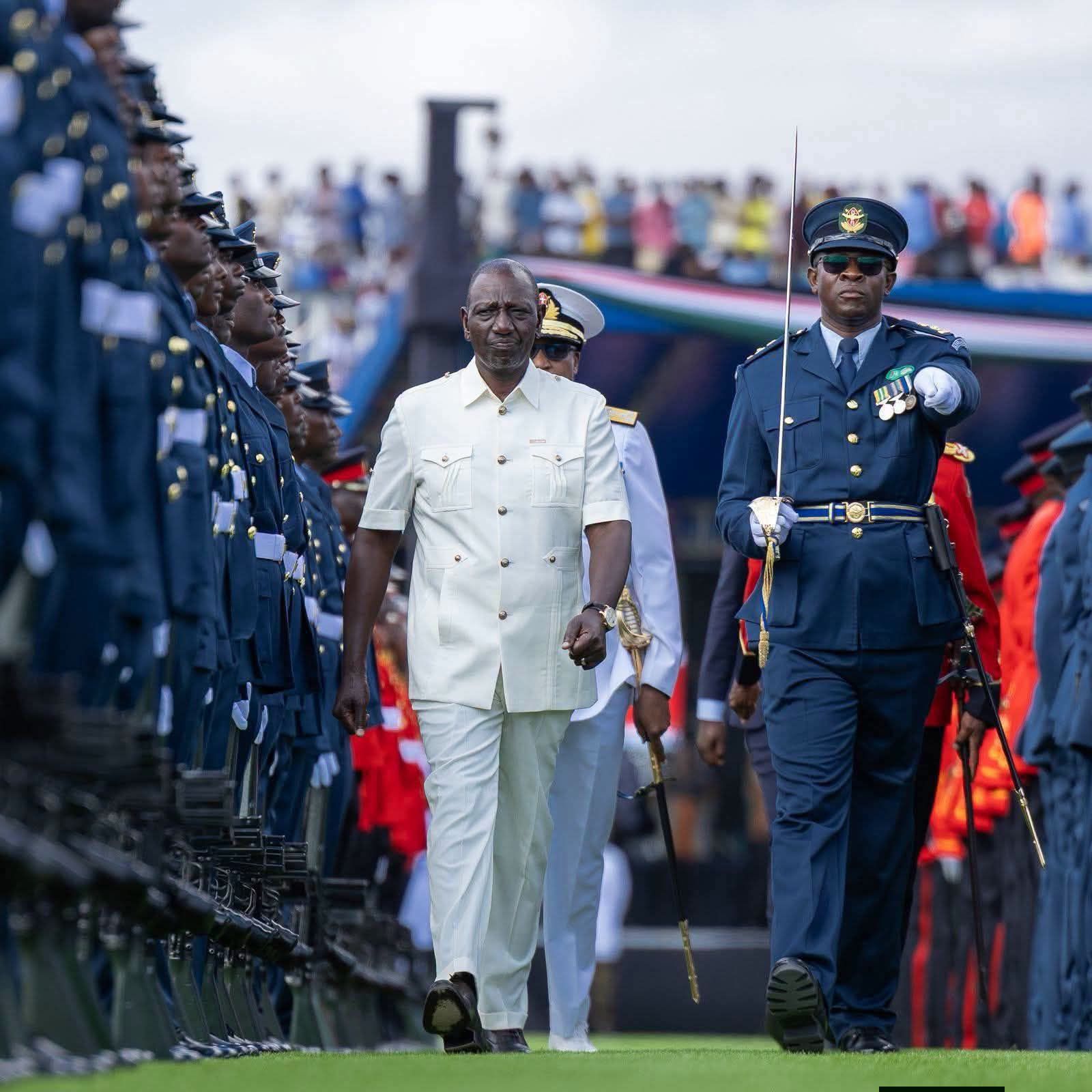
President William Ruto presided over the celebrations, leading the nation in honouring the sacrifices of freedom fighters and independence pioneers while using the occasion to spotlight his administration’s agenda on inclusion, education, infrastructure and economic transformation.
The event, held under the theme “Education, Skills and the Future,” focused on education reforms, skills development and youth empowerment as central pillars of Kenya’s long-term development strategy.
Hosting the national celebrations in Wajir marked a significant milestone for North Eastern Kenya, a region that has for decades cited exclusion from mainstream development, inadequate infrastructure and limited access to public services.
“This is Wajir County, and this is Kenya,” Ruto told a packed stadium. “For the first time in 63 years of self-rule, a national celebration, Madaraka Day, is being hosted here in Wajir, in the heart of northern Kenya. This is not a mere ceremonial gesture. It is a national declaration.”
The president described the decision to hold the celebrations in Wajir as a recognition that national development and citizenship rights should extend equally to all parts of the country.
He acknowledged what he termed decades of neglect and policy failures that left large parts of northern Kenya behind following independence.
“Decades after independence, this region was left behind through neglect, marginalisation, discrimination and policy failures,” Ruto said.
He cited the effects of development policies that concentrated investment in what were considered high-potential areas while regions such as the former North Eastern Province remained underserved.
“The consequences were devastating and long-lasting,” he said. “Decades without adequate roads, without water, health or schools, communities pushed to the fringes of their own republic.”
Apology
In one of the most notable moments of the celebrations, Ruto issued what he described as an apology on behalf of the nation to residents of northern Kenya.
“On behalf of the people of Kenya, today, as I stand here as president and leader of our great nation, to the people of northern Kenya, for this marginalisation, I want to apologise on behalf of the nation of Kenya,” he said.
“It was never meant to be this way.”
The president linked the theme of this year’s celebrations to the government’s education agenda, arguing that the next phase of Kenya’s development would be driven by knowledge, innovation and skills.
“Unlike in 1963, the next frontier of Kenya’s liberation will not be fought on conventional battlefields,” he said.
“It will be won in classrooms and lecture halls, laboratories and workshops, and in innovation hubs.”
Ruto said the Competency-Based Curriculum was designed to equip learners with practical skills and problem-solving abilities while preparing them for participation in a modern economy.
According to the president, 52 percent of learners in Kenya’s first Grade 10 cohort have selected science, technology, engineering and mathematics pathways.
“This tells us that a new generation is rising, one that will drive Kenya’s industrial transformation, power our technological advancement and build the innovation economy that will define our nation’s next chapter,” he said.
The president highlighted increased government spending on education, saying the education budget had grown from 500 billion shillings in 2022 to more than 702 billion shillings.
He said the government had recruited more than 100,000 teachers over the past three years and planned to hire an additional 20,000 this year.
Ruto also pointed to efforts to address chronic teacher shortages in northern Kenya through the operationalisation of teacher training colleges.
He said 1,800 local teachers from Wajir, Mandera and Garissa counties had been employed under an affirmative action programme and would be deployed within the region.
In addition, 4,616 students from the three counties are currently enrolled in teacher training colleges, which he described as the highest number in the region’s history.
Citizenship
Beyond education, the president highlighted reforms aimed at addressing long-standing concerns over citizenship documentation in northern Kenya.
Ruto defended a presidential declaration issued earlier this year aimed at reforming the registration and issuance of national identity cards and birth certificates in northern Kenya and other counties.
He said the move ended discriminatory practices that had subjected residents to additional vetting procedures while maintaining safeguards to ensure only legitimate Kenyan citizens receive national documents.
“We did not abolish verification of citizenship,” he said. “We abolished discrimination.”
On infrastructure, Ruto outlined a series of investments underway across Wajir and neighbouring counties.
He said the government had invested heavily in affordable housing, education facilities, healthcare infrastructure and road construction as part of broader efforts to integrate northern Kenya into the national economy.
Flagship projects
Among the flagship projects highlighted was the 750-kilometre Northern Kenya Gateway Corridor linking Isiolo, Wajir and Mandera.
Ruto described the project as the most significant road investment undertaken in the region since independence.
“This is more than a road project,” he said. “It is a bridge between exclusion and opportunity, between neglect and investment and between the Kenya that was and the Kenya that we are building together.”
The president said the project would cost close to 100 billion Kenyan shillings.
He also pointed to housing developments valued at 15.6 billion shillings in Wajir County, including residential units, markets and hostels currently at various stages of construction and procurement.
Across Wajir, Garissa and Mandera counties, projects valued at approximately 38.5 billion shillings are being implemented, he said.
Ruto further highlighted healthcare reforms under the Social Health Authority, saying about 800,000 residents from Wajir, Garissa and Mandera counties had registered under the programme.
He said the authority had paid 8.1 billion shillings in healthcare claims within the three counties.
The president also announced measures aimed at improving access to education for children enrolled in alternative learning systems, including Duksi, Madrasa and pastoral instruction programmes.
He directed the Cabinet Secretary for Education to engage stakeholders and recommend measures for integrating such programmes into the formal education framework.
“This will ensure that every child, regardless of background or circumstance, has a recognised pathway into learning, skills and opportunity,” he said.
Livestock development, a critical sector in northern Kenya, also featured prominently in the president’s address.
Wajir Governor
Wajir Governor Ahmed Abdullahi described the hosting of Madaraka Day celebrations in the county as a historic turning point for both Wajir and the wider North Eastern region.
“Your Excellency, the people of Wajir have waited for this day. They prayed for this moment,” the governor said.
“A day when they host you, their president, a day they get the attention of other Kenyans and stand shoulder to shoulder with the leadership of the Republic.”
Abdullahi said the event signified that Wajir was no longer viewed as remote or peripheral but had become part of Kenya’s broader national development agenda.
“Wajir is no longer remote and peripheral. It is fully integrated into the country’s shared imagination and future.” He said
The governor referenced historical grievances that have shaped public discourse in the region, including citizenship challenges, underdevelopment and past episodes of violence.
He specifically cited the 1984 Wagalla massacre in Wajir, as well as other incidents in the region, while noting that significant changes had occurred since the introduction of multiparty democracy, the promulgation of the 2010 Constitution and the implementation of devolution.
Healthcare services
Abdullahi highlighted improvements in healthcare services as an example of the region’s transformation.
He said Wajir had only one doctor serving a population of approximately 700,000 people before devolution in 2013.
Today, he said, the county has 76 medical officers, more than 1,100 healthcare professionals and 174 health facilities, alongside modern theatres and emergency services in sub-county hospitals.
The governor also credited the hosting of Madaraka Day celebrations with accelerating infrastructure improvements within Wajir town and its surrounding areas.
He cited the construction of the new stadium, additional roads, rehabilitation of existing roads, drainage works and improvements to the airport runway.
The record turnout underscored Wajir’s growing prominence as one of Kenya’s emerging urban centres and reflected the significance attached to the decision to host a national celebration in a region that has long sought greater visibility and inclusion within Kenya’s national development agenda.


