

 By Azizah Abdullahi
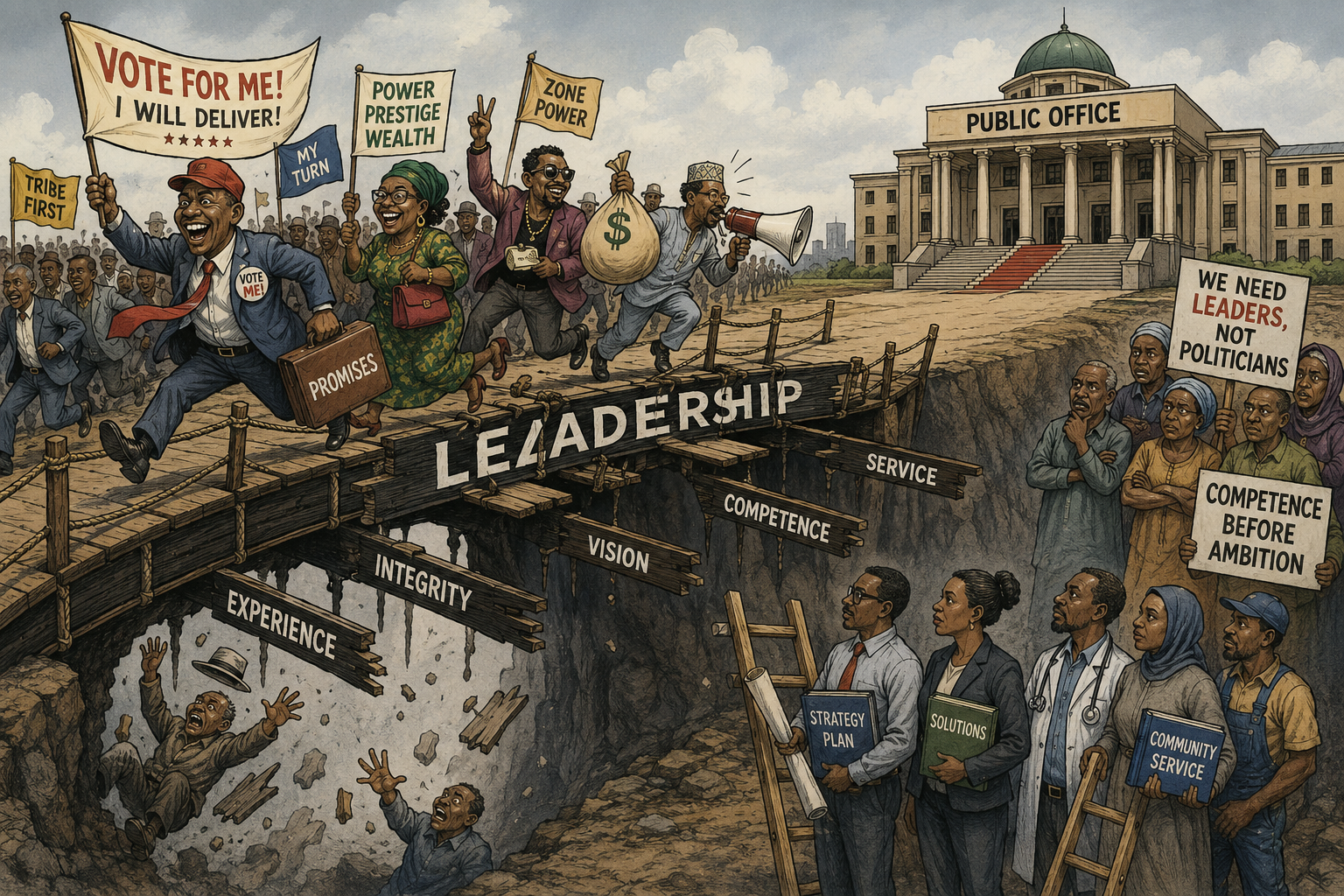
I can say without fear of contradiction that Northeastern Kenya suffers from a glaring leadership deficit. This is not because the region lacks capable people or ambitious individuals, but because leadership itself remains one of the most misunderstood concepts within our political culture.
Every election cycle, we produce leaders whose campaigns are energetic but whose understanding of governance, public service and institutional leadership is often shallow. The consequences are evident in weak institutions, stalled development and growing public disappointment.
Over the years, I have interviewed political leaders, analysed their manifestos, reported on their performance and lived within the communities they represent. That experience has reinforced one conclusion which is that many of those who seek public office are not adequately prepared for the responsibilities that come with it.
Their performance in office frequently reveals a gap between winning an election and exercising effective leadership. Elections reward popularity and mobilisation, but governing demands competence, discipline and vision.
This challenge is particularly evident in areas where negotiated democracy and clan arithmetic play a dominant role in determining electoral outcomes. While these arrangements may promote inclusion and reduce electoral conflict, they can also weaken merit-based leadership if community negotiations become more important than competence and integrity.
When leadership selection gives greater weight to identity than to ideas, qualifications and character, the public often pays the price long after the election is over.
Winning an election should never be mistaken for being ready to govern. A candidate may have the resources to finance campaigns, cultivate influential networks or project an image of generosity, but none of these qualities automatically translate into effective public leadership.
Leadership is ultimately measured not by campaign rallies or political slogans but by the ability to make sound decisions, manage public resources responsibly, strengthen institutions and improve people’s lives.
One worrying trend is the growing number of political newcomers entering the race without any meaningful leadership experience or demonstrated record of public service. Many have never managed complex organisations, led successful teams or solved community problems.
Those seeking public office should demonstrate some evidence of competence, ethical judgement and a capacity to manage competing public interests before asking citizens to entrust them with public resources.
Even more troubling is the willingness of communities to elevate individuals whose personal integrity is questionable. Public office requires more than ambition. It demands moral authority, accountability and a genuine commitment to serving others.
Political science often distinguishes between transactional leadership, which relies on exchanges of favours and patronage, and transformational leadership, which seeks to inspire change, strengthen institutions and leave society better than it was found. Too often, our politics rewards the former while neglecting the latter.
Some aspiring politicians appear more interested in mastering the tactics of political survival than the principles of good governance. The pursuit of power without an understanding of public administration, budgeting, policy implementation or accountability creates leaders who know how to win elections but struggle to govern effectively.
Leadership should never be viewed as an avenue for personal enrichment or social status, it is a public trust that carries enormous responsibility.
For Muslim leaders, this responsibility carries an even deeper moral dimension. Islamic teachings emphasise justice, honesty, humility and service to the people. Authority is viewed as an Amanah, a trust for which leaders are ultimately accountable before both society and Allah.
When leadership is driven by personal ambition, greed or the pursuit of influence, it departs from these principles. History, including the Qur’anic account of Korah (Qarun), reminds believers that wealth, power and arrogance are temporary and that injustice ultimately carries consequences.
Poor leadership rarely harms only the individual holding office. It affects entire communities. Leaders who prioritise personal interests over public welfare weaken institutions, deepen divisions, discourage investment and delay development.
Instead of building consensus and expanding opportunities, they often become sources of conflict and mistrust. Weak institutional capacity, poor policy implementation and ineffective oversight eventually translate into poor roads, inadequate healthcare, struggling schools and limited economic opportunities.
Whenever I ask aspiring politicians why they are seeking office or what specific reforms they hope to deliver, the answers are often disappointing. Many struggle to articulate a coherent development agenda or demonstrate an understanding of how government actually functions.
Few speak convincingly about budgeting, legislative oversight, institutional reform or long-term planning. This should concern every voter because leadership is fundamentally about solving problems, not merely occupying positions of authority.
Perhaps the greatest weakness lies in how some leaders emerge. In many cases, an individual simply declares an interest, secures the backing of influential elders and immediately becomes a serious political contender.
There is little scrutiny of ideas, leadership record, ethical conduct or policy competence. Communities deserve a more rigorous process that evaluates not only popularity but also character, experience and the ability to govern effectively.
There is nothing wrong with ambition when it is anchored in competence and public service. The danger arises when ambition exists without preparation. In such circumstances, inexperienced leaders often fall under the influence of corrupt political mentors, adopting the same habits of patronage, impunity and self-enrichment that have undermined public confidence for generations.
Northeastern does not lack political talent. It lacks a culture that consistently rewards leadership competence over political convenience. If we continue choosing leaders based primarily on clan calculations, popularity or financial influence rather than vision, integrity and capability, we should not be surprised when development continues to lag behind our aspirations.
Our future depends on choosing men and women who understand that public office is, above all, an obligation to serve with wisdom, justice and competence.


