

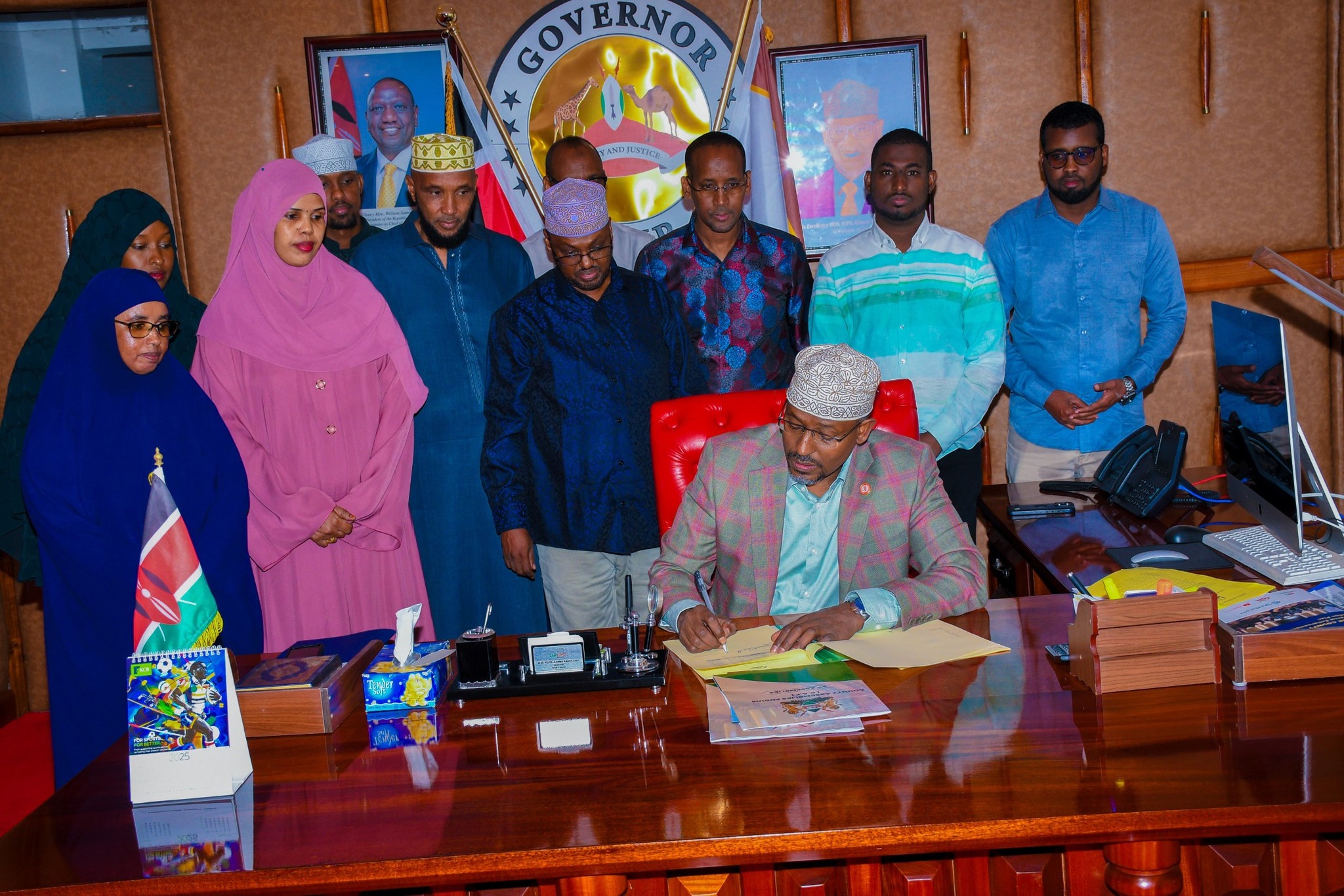
Wajir Governor Ahmed Abdullahi on Wednesday assented to the Wajir County Appropriation Bill, 2025, marking the conclusion of a budget-making process that had faced delays and legal hurdles.
The move came just a day after the County Assembly adopted the Finance, Budget and Appropriations Committee report.
The signing ceremony, held at the Governor’s office on Wednesday, was witnessed by the County Assembly Speaker, Hon. Abdille Yussuf Mohamed, the Chairperson of the Budget Committee Hon. Nimo Ahmed Saney, committee members, and several Members of the County Assembly.
Governor Abdullahi described the event as a critical step that would pave the way for timely implementation of programmes.
“This step ensures the timely implementation of the 2025 budget, laying a foundation for improved service delivery and sustainable development across Wajir County,” he said in a statement posted on his official Facebook page.
The process leading to the approval had been prolonged, with a protracted court dispute over the membership of the Finance, Budget and Appropriations Committee threatening to derail the exercise.
Its conclusion has come as a relief to many residents who were anxiously waiting for clarity on the county’s financial roadmap.
The 2025/26 budget, which stands at KES 13,994,375,471, was subjected to public participation through grassroots forums at sub-county levels.
While presenting the committee’s report, Hon. Nimo Ahmed Saney praised residents for their robust involvement, noting that their views significantly informed the final allocations.
“The Committee is also grateful to the residents of Wajir County for honoring the invitation to participate in the budget hearings and for expressing their views and priorities”
Public Concerns
During public engagements, residents raised pressing concerns. They urged the County Government to settle outstanding debts owed to contractors, suppliers, and service providers before launching new development projects.
Following the public outcry, the administration allocated KES 320 million for clearing pending bills, a step expected to restore credibility with business partners and ease the financial strain on contractors.
There were also calls for more investment in youth empowerment through skills development, entrepreneurship, ICT hubs, and greater inclusion in procurement opportunities.
The pastoral economy stakeholders pressed for the construction of modern slaughterhouses and meat processing facilities to expand market access whileuUrban and peri-urban communities demanded designated dumping sites and improved solid waste management, while others raised alarms over the spread of the invasive Mathenge tree, calling for its eradication and replacement with more productive indigenous species.
Budget Breakdown
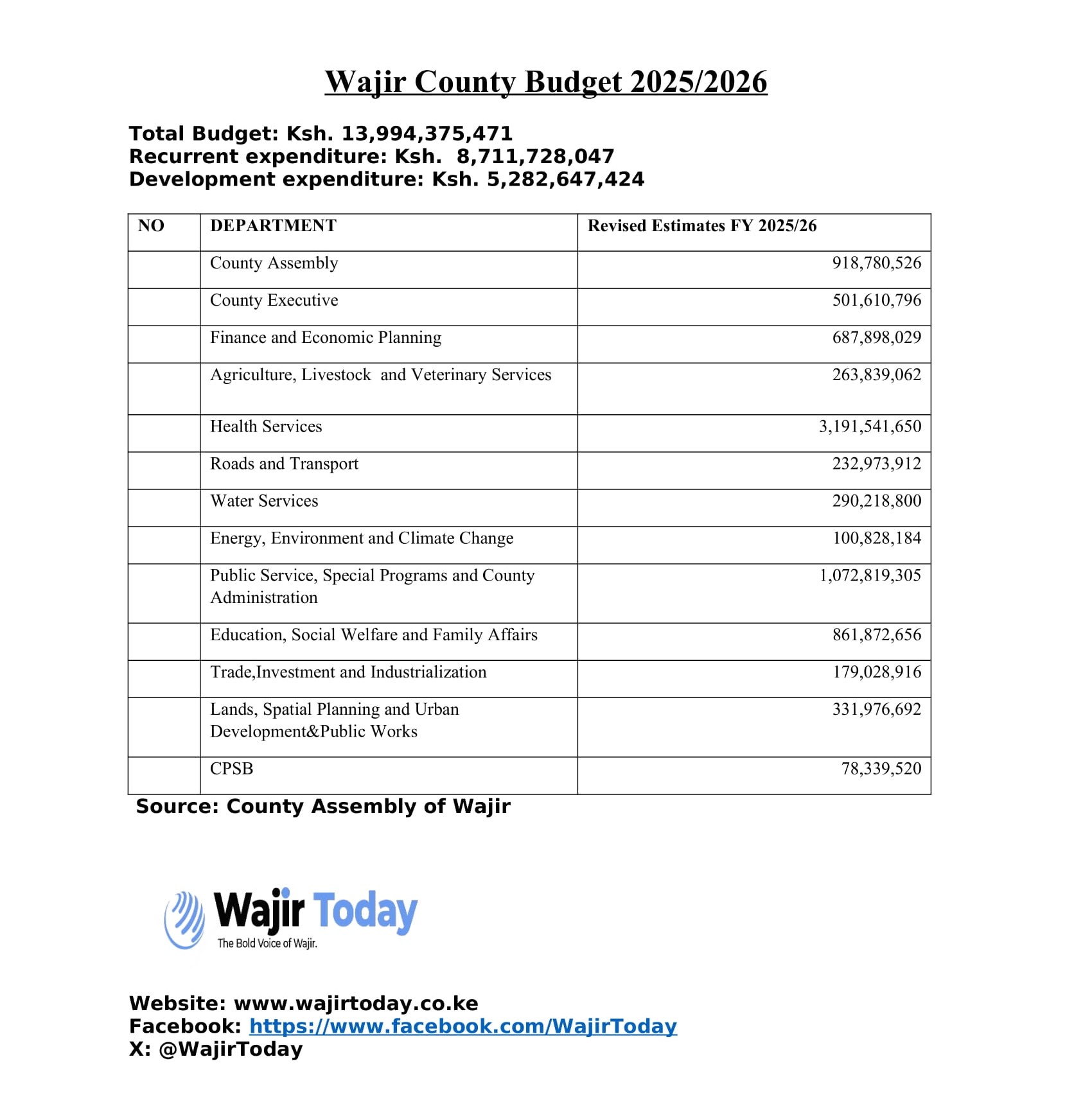
The budget provides KES 8,711,728,047 for recurrent expenditure and KES 5,282,647,424 for development programmes.
The County Assembly has been allocated KES 918,780,526, while the County Executive will receive KES 501,610,796. The Department of Finance and Economic Planning has been allocated KES 687,898,029, Agriculture, Livestock and Veterinary Services will get KES 263,839,062, and Health Services has been allocated the lion’s share at KES 3,191,541,650.
The Roads and Transport docket will receive KES 232,973,912, while Water Services has been allocated KES 290,218,800. The Department of Energy, Environment and Climate Change has been given KES 100,828,184, and Public Service, Special Programmes and County Administration will get KES 1,072,819,305.
Education, Social Welfare and Family Affairs has been allocated KES 861,872,656, while Trade, Investment and Industrialisation will receive KES 179,028,916.
Lands, Spatial Planning, Urban Development and Public Works has been allocated KES 331,976,692, and the County Public Service Board will receive KES 78,339,520.


