

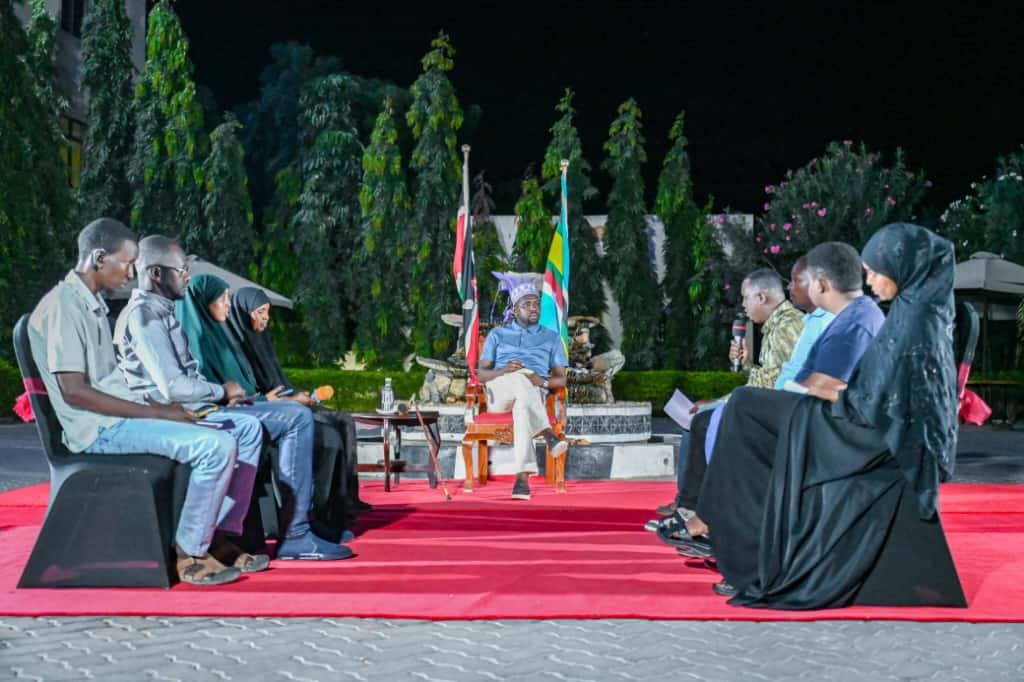
By Staff Writer | Wajir Today | Tuesday, 23 September 2025
Interior and National Administration Cabinet Secretary Kipchumba Murkomen on Tuesday evening assured residents of Wajir County that the government is stepping up investments in security and infrastructure to tackle longstanding challenges of marginalisation, insecurity, and limited connectivity in northern Kenya.
Speaking during an engagement with Wajir-based media, Murkomen said security cannot be addressed in isolation from development, underscoring the government’s approach that combines infrastructure expansion, community policing, and strengthened border security.
“Security in the region or any other part of our country, which is still marginalised, cannot be looked at in isolation. That’s why the Government has embarked on major road network development in the region,” he stated. “Besides enhancing connectivity, we are also boosting community policing and strengthening border security.”
Murkomen emphasised that counties in the Arid and Semi-Arid Lands (ASALs) face the greatest challenges in the country, with marginalisation directly linked to insecurity.
“Every conversation about development is also about security,” he said, noting that security reforms remain central to the government’s agenda. “There has been continued investment in the security sector. There is a lot of work to be done especially to equip local security infrastructure in the region and to increase deployment.”
The CS highlighted the ongoing construction of the 750-kilometre Isiolo–Mandera highway as a landmark project that will transform mobility, improve economic opportunities, and reduce insecurity.
“This is a big deal for the government,” he said.
Addressing the issue of the Kenya–Somalia border, Murkomen stressed that security considerations remain the primary factor behind the continued closure.
“The question of the border is critical. The only reason why it remains closed is because of security issues. This is not a problem for Wajir alone but for the rest of the region,” he explained.
He said Nairobi continues to engage Somalia, IGAD, and international partners to address cross-border insecurity before any steps are taken towards reopening. “We will continue engaging so that Somalia can be helped,” he added.
In a move aimed at boosting inclusivity, Murkomen urged Wajir residents to take advantage of the government’s abolition of vetting for national identity cards.
“I urge the people of Wajir to take advantage of abolition of vetting. We are bringing digital machines on the ground. People will be able to get their national identity cards in three days,” he said. “We are opening doors and advancing constitutional inclusivity.”
Murkomen also addressed concerns over the disappearance of Wajir Huduma Centre Manager, Hussein Abdirahman Mohamed, assuring the public that the government does not condone abductions.
“Any case of abductions is not sanctioned by the government. We do not have a policy of abduction and we do not condone any act of abduction,” he said.
Director of Criminal Investigations (DCI) Mohamed Amin added that investigations into the case were ongoing.
“We are still continuing with investigation of the case of the Huduma Centre Manager. So far, we have not established any abduction or forced disappearance and the investigations continue,” Amin said.
Murkomen reiterated that the government’s strategy for northern Kenya seeks to address historical injustices through investments in infrastructure, technology, and inclusive governance.
By linking development to security, he said, the state aims to dismantle the cycle of marginalisation and restore public confidence in state institutions.
“Asal counties have the greatest challenges in the country. There is a direct correlation between marginalisation and insecurity,” he said


